

What lies beyond protests.
on the difference between protests and movements.

After the Streets Went Quiet
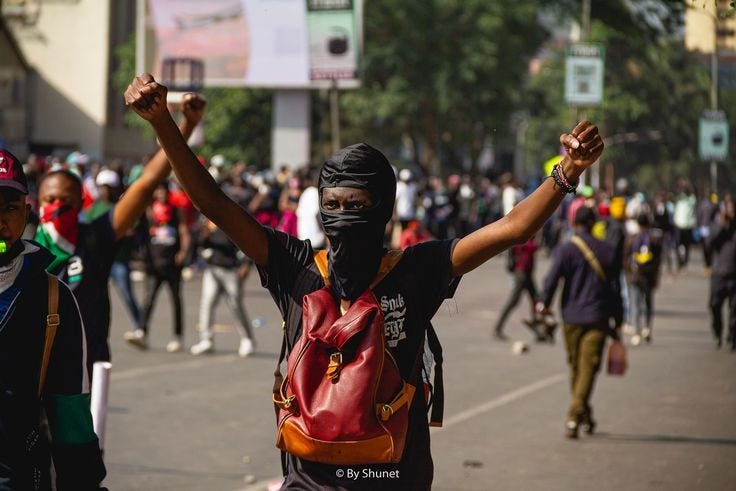
On June 25, I do not think of the fire and billowing smoke first, or crowds, and streets manned by police.
I think of the silence that followed.
I think of the strange speed with which a country can return to ordinary life, as though grief were an interruption, as though blood on the pavement were no more than rainwater, as though the dead could be carried into the evening news and left there. I think of the way Kenya knows how to gather, how to shout, how to run, how to mourn, how to post, how to remember for a day — and then how to withdraw into the very life that made protest necessary.
Two years have passed since the protests of 2024 shocked the nation. Two years since young Kenyans stood before power and refused to behave like guests in their own republic. Two years since Parliament stopped being an abstraction and became, if only for a few hours, a place where public anger arrived in the flesh. Two years since many of us realised that political consciousness had not died in Kenya. It had only been waiting for a generation less willing to inherit despair as a national duty.
But I am no longer certain that awakening is movement or that political awakening directly leads to political change.
An awakening may happen in a day. A movement cannot. It endures, and endure we have not.
A protest can be summoned by outrage, by grief, by hunger, by taxation, by betrayal, by arrogance, by the exhaustion of being governed badly. But a movement requires more than summoning. It requires memory. It requires discipline. It requires citizens who can meet after the smoke clears and turn slogans into study, study into structure, structure into pressure, pressure into policy, and policy into a new political culture. A protest may be an eruption. A movement must become an institution of the people.
This is where we failed, or where we are still failing.
I say “we” because I do not want the false comfort of distance. I, too, have mistaken presence for progress. Believed that being there, or speaking about being there, was its own achievement. I have watched the national mood rise like a tide breaking its banks and felt, for one brief moment, that history had finally turned its face toward us. There was the flag in the hand, the chant in the throat, the phone raised as witness, the sudden and necessary knowledge that one is not alone. That we did not bare the future or destiny of this country by our individual hands. That feeling matters. A nation cannot be changed by citizens who have never felt each other.
But feeling is not enough, presence is not enough, numbers are not enough, and outrage is not enough; without direction, feeling dissipates, without structure, presence dissolves, without purpose, numbers scatter, and without strategy, outrage burns out.
A crowd can shake a government for an afternoon. Only organization can trouble it for a generation.

Kenyan political life has perfected the art of exhausting the citizen. It does not always defeat us by argument. It defeats us by fatigue. It makes food expensive, public service humiliating, accountability procedural, justice slow, corruption familiar, and politics appear like a private business conducted by public men. It teaches the ordinary person to survive first and question later. It turns apathy into a kind of prudence.
This is the quiet genius of a broken political culture: it does not need every citizen to love the state. It only needs enough citizens to believe that nothing can be changed.
I have come to realise that apathy in Kenya is not always laziness. Often, it is an economy. It is a survival strategy. It is the boda rider choosing a day’s income over a day in the streets. It is the mother measuring principle against school fees. It is the graduate who has sent out enough applications to know that hope can become humiliating, debilitating, and murderous. It is the worker who cannot afford to be arrested. It is the young person who understands that martyrdom photographs well but does not feed the family left behind.
And because apathy is rewarded, movements in Kenya are born already fighting a private war within the citizen. Before a movement confronts the state, it must confront despair. It must confront itself and persuade people that not only is participation noble, but that participation is useful. It must prove that politics is not only what happens in elections, not only what happens in Parliament, not only what happens when leaders speak from platforms, but what happens when citizens acquire durable habits of attention.
That was the work we avoided after 2024.
We commemorated. We argued. We exposed. We mourned. We posted names. We condemned police brutality. We demanded resignations. We followed hashtags as if they were roadmaps. We refreshed timelines as if the next stage of the struggle might announce itself between outrage and entertainment. But we did not build enough spaces where political consciousness could mature. We did not build enough ward-level civic cells. We did not train enough people to read budgets, follow bills, monitor county assemblies, protect protesters legally, document violations safely, speak across class, speak across tribe, speak across the rural-urban divide, and turn national anger into local leverage.
We had fire, but we did not build enough furnaces.
So the pattern returns. A date is chosen. A route is announced. Police warn. Politicians circle. The public debates whether the protest is genuine, infiltrated, necessary, dangerous, hijacked, or futile. Roads are blocked. Shops close. Families worry. The young arrive with courage. The cameras arrive with appetite. The old political class arrives with the instinct of ownership. By evening, the country counts arrests, injuries, speeches, damage, betrayal, and hashtags. Then, after the noise, the people return to the long loneliness of being citizens without recourse.
This is not enough.
It is not enough to inherit the forms of earlier struggle without adapting their logic. Saba Saba belonged to its own terrain. The fight for multiparty democracy belonged to its own architecture of repression and possibility. Those who fought then understood the instruments available to them: rallies, churches, unions, underground networks, foreign pressure, pamphlets, parties, detention, exile, and public defiance. Their courage deserves honour. But honour becomes a prison when imitation pretends to be continuity.
Kenya cannot confront the future using only the rituals of the past. A generation raised by mobile money, digital surveillance, unemployment, debt, climate anxiety, influencer politics, police violence, and algorithmic distraction cannot organise as though it lives in the 1990s. The state has evolved. The media environment has evolved. The politician has evolved. The protester too must evolve.
The modern Kenyan protest cannot only be a march to the CBD. It must also be a school. It must be a legal desk. It must be a budget office. It must be a neighbourhood committee. It must be a mental-health network. It must be a data archive. It must be a bail fund. It must be a voter registration drive. It must be a civic syllabus. It must be a county-level accountability machine. It must be a disciplined refusal to let one dramatic day substitute for the slow architecture of power, because power understands spectacle. It has learned how to survive it.
Power waits for the crowd to tire. Power waits for rent to be due. Power waits for funerals to end. Power waits for influencers to disagree. Power waits for leaderless anger to become leaderless confusion. Power waits for politicians to enter through the open door of disorganisation and rename themselves custodians of a pain they did not carry. it waits for citizens to mistake motion for movement, attendance for strategy, and commemoration for consequence.
This is why the casualness of our protest culture troubles me. We say “turn up” before asking what happens after people turn up. We say “occupy” before building the capacity to remain. We say “reject” before building the mechanism to replace. We say “leaderless” when sometimes we mean structureless. We say “organic” when sometimes we mean unprotected. We say “the people” when we have not done the patient work of making the people powerful beyond the day of confrontation.
The citizen has obligations, yes. But obligation without preparation eventually becomes moral blackmail. It is easy to tell people to rise but remains a much harder task to build something worthy of their risk. If we call people into the streets, we must also call them into study, into building, organising and teaching ways of solidarity. If we ask them to face tear gas, we must also ask them to understand the public finance system that made the tear gas necessary. If we ask them to chant against corruption, we must also show them how procurement hides theft, how committees bury accountability, how public participation is manipulated, and how laws move quietly before they become national emergencies.
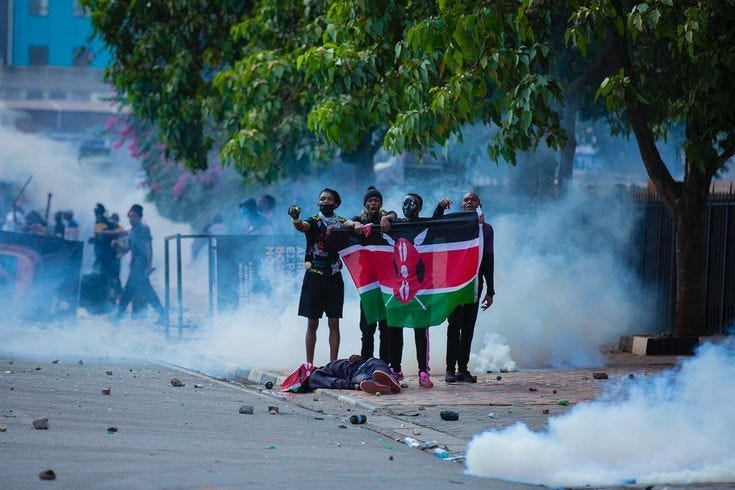
Political consciousness is not a mood. It is a capacity. it is not a privilege of the few but an opportunity for the many. It is the power to call things by their true names. It is the discipline to choose the real target and not exhaust ourselves fighting shadows. It is the judgment to know when to dramatise and when to negotiate, when to record and when to resist, when to stand firm and when to step back without surrender. It is the resolve to make participation simple enough for the weary citizen and costly enough for the comfortable ruler.
A serious movement does not ask only, “How many people came?”
It asks: Who left with a role? Who was trained? Who was protected? Who joined a local structure? Who learned to follow a bill? Who registered to vote? Who mapped their MCA, MP, senator, governor, committee chair, police commander, and procurement officer? Who can explain the issue to a parent in Kisii, a trader in Gikomba, a fisherman in Homa Bay, a nurse in Kakamega, a student in Eldoret, an office worker in Mombasa, a farmer in Meru, and a tout in Nairobi without reducing politics to tribal suspicion or elite gossip?
That is the test. The state fears the crowd for a day. But an organised citizenry puts permanent fear on state machinery that can last a lifetime. This is why politicians so easily take advantage of nonmovement. They understand vacuums. They know that if the young do not build a disciplined public platform, someone else will stand on their grief and call it leadership. If the movement does not define its demands, politicians will translate them into campaign language. If the movement does not guard its memory, politicians will lay wreaths over it. If the movement does not build continuity, politicians will convert anniversaries into stages.
And so, two years later, the memorial itself becomes a mirror. Who owns the day? The families? The young? The dead? The opposition? The government? The cameras? The police? The country? Or does the day belong to the unfinished work that all of them reveal?
I do not want to remember June 25 only by returning to the street. I want to remember it by refusing to let the street be the only instrument of citizenship.
We must build a politics in which young Kenyans need not pay with their lives before the nation hears them. We must build a politics in which mourning is not the only language the country understands. We must build a politics in which the citizen is not summoned in crisis and dismissed when the work begins. We must build a politics in which courage is gathered, trained, protected, and directed before it is spent.
Let us refuse distraction as a form of surrend and in our refusal let us become less available to the old fractures of tribe, less purchasable by appointments, less flattered by speeches, less deceived by token reforms, and more unwilling to trade justice for compensation without accountability. Let us be less shaken by displays of force, less resigned to the slow grind of delay, and less fooled by leaders who remember the people’s pain only when cameras begin to roll.
The aftermath of 2024 asks something more difficult of us than remembrance. It asks whether we can become worthy of our own awakening. The dead do not need our performance. They need our seriousness. They need citizens who can carry grief into structure. Young people who can refuse both apathy and empty spectacle. They need artists, lawyers, medics, students, workers, journalists, coders, clergy, teachers, traders, and parents to understand that democracy is not a feeling we visit on national days. It is a discipline we practice when nobody is clapping.
A republic is not saved by one heroic afternoon. It is saved by citizens who make freedom habitual. So let this anniversary not be the yearly return of emotion without construction. Let it not be another day when we gather, scatter, and wait for the next wound. Let it not become a stage for the same political class that has learned to feed on public memory. Let it be the day we admit that the protest was not the end of our duty, but the beginning of our organised political struggle.
We must build what we have been asking for. Build movements that can think, and not only react. Build structures capable of receiving new people without losing direction. Imagine ourselves capable of building civic education avenues that travels faster than propaganda. Believe in our capacity to build local accountability so that national betrayal becomes harder. Contend with our ability to build courage that does not depend on virality. Solidarity that can survive disagreement. Tactics that change because power changes. Memory that cannot be captured by those who arrive late and speak loudly.
There are times in the life of a country when neutrality is not peace, when patience is not wisdom, when silence is not maturity, and when order without justice is only fear in official dress. There are moments when a generation must decide whether it was awakened merely to witness decline or awakened to arrest it.
This is such a time.
Let those who govern understand that the Kenyan citizen is not a seasonal instrument of outrage. Let those who mourn understand that memory can become machinery. Let those who fear understand that fear, honestly shared, can become courage. Let those who are tired understand that citizenship is not the absence of exhaustion, but the refusal to let exhaustion have the final word.
We do not ask for a country that saves us while we sleep. We ask for the strength to build one while we are awake.
And if June 25th is to mean anything beyond sorrow, let it mean this: that we shall no longer confuse the crowd with the movement, the chant with the strategy, the anniversary with the work, or the presence of politicians with the presence of power.
Let it mean that we accept, without illusion and without delay, that the burden of this republic rests not in speeches, not in offices, not in ceremonies, but in the hands of its citizens. Let it mean that we shall not wait for permission to act, nor for leaders to discover courage we have already shown. Let it mean that we shall measure our patriotism not by what we demand of Kenya, but by what we are prepared to build for it.
The work is ours.
The country is ours.
And the future — if it is to be just, if it is to be free, if it is to be worthy of those we remember — will not be shaped by chance. It will be shaped by the will we summon, the discipline we sustain, and the courage we refuse to surrender.
This is why I feel like sometimes activism in Kenya is just a trendy aesthetic.
Sometimes people mean it but after sometime it looses its meaning and people go on as if whatever they were protesting about never happened.
This was an eye opener for real to look beyond.
insightful