

In protesting
I found the antidote to my apathy.

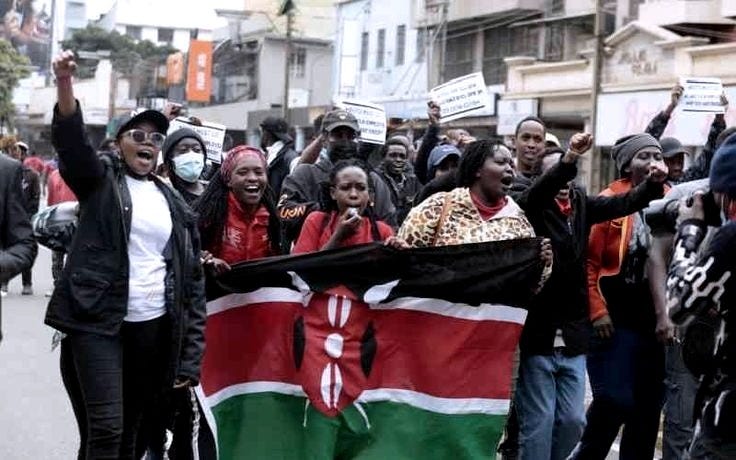
I was within the CBD at 6 pm, June 25th 2024. Black billowing smoke rose through the air as the sun hung low. I was walking towards Quickmatt Pioneer along Moi Avenue after sitting for a short while on the concrete blocks outside the August 7th Memorial Park. As I sat there, I could still hear police sirens, tear gas canisters exploding from a distance, and the screams and shouts of people still protesting and refusing to leave for home.
I was tired, my eyes stung after repeated exposure to tear gas smoke throughout the day, and the soles of my feet burned, hurt and threatened to detach themselves from the rest of my body. My girlfriend, who by then had been with me for two years, silently sipped water from a water bottle, washing her face with it, as she waited beside me, relieved that we had stopped moving. The city clocks along Moi Avenue had all but been destroyed, and the railings along the road also suffered the same fate. Despite the evident large destruction of property in this part of town, people still milled around, sat and stood in groups, and the police presence was very minimal. Naivas supermarket, an anchor tenant at the ground level of the Development house where the Rongai bus station stood, had been completely looted.
I did not know this, as it had occurred while we were several streets away along Kenyatta Avenue, where we had spent the majority of our day being chased and pushing back against the police while trying to make our way towards parliament.
We were along Uhuru Highway when they breached the parliament gates. The empty Intercontinental Hotel was to our left, the parliament fence on our right, leaning and pressed down by the masses of people who had managed to storm through it. We did not dare to step onto the grassy lawns of Kenyatta’s mausoleum, even though we had witnessed the moment when the police barricade along the roundabout leading to Processional Street retreated towards Parliament. We chased away the police enthusiastically before a water cannon truck came speeding towards us from the Haile Selassie roundabout, spraying us back to where we had been through most of the day.
What I witnessed on Tuesday, June 18th, Thursday, June 20th, and the following week on Tuesday, June 25th, will forever be engraved in my mind. On the first day of the Gen Z-led protests, I made my way to town quite early. By 9 a.m., I was already outside Nation Media House on Kimathi Street, along with my partner and many other young citizens, all dressed in black. Since I wasn't on Substack, I documented the events of those days on my WordPress blog. The decision to wear black felt significant when we consider the reasons that brought us to the streets. However, it proved to be a poor strategic choice, as it made us easily identifiable to the police, who could distinguish between those dressed in black and those who were not. It was no surprise that a lot of young people were defiantly arrested on that day.
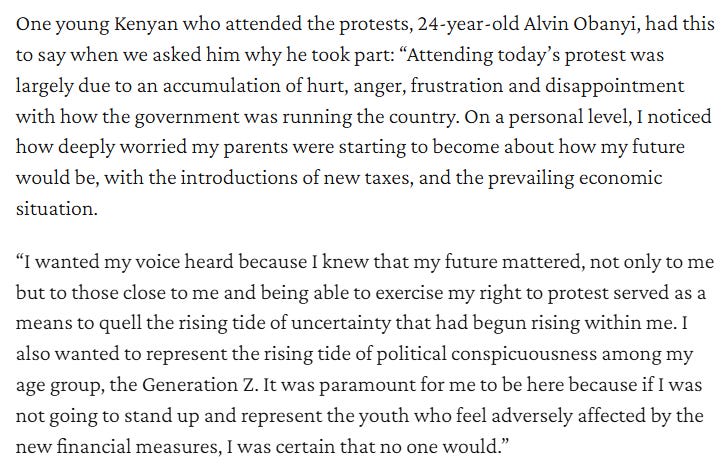
I think in hindsight, going to these three protests naively helped me identify the gap between activism and political change that has now become apparent in how we exercise our civic duties. It seemed quite patriotic to be outside, running in the streets, putting myself in danger while other older people watched from the confines of their closed shopping stalls, and within the walls of their buildings. Patriotism without the shared solidarity of others does not result in any meaningful gain; it is seen as a performance and an entertainment of the times we live in.
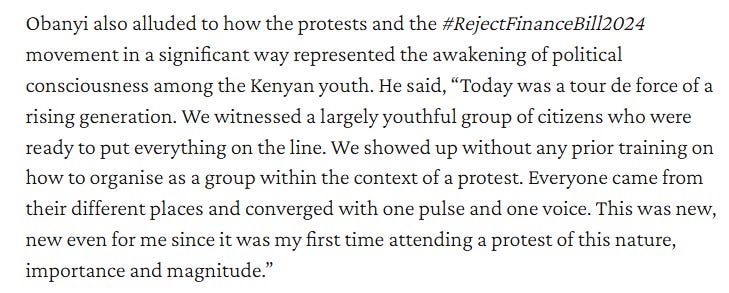
I shared this article the following day with my father, who had bravely allowed me to go to protest the previous day. He, in turn, shared it with the family WhatsApp group, cementing me as the activist, the one among them who was engaged in the movement of the day, which was something that my father felt proud of, since he too was actively engaged in politics during the Moi era as a student of journalism while studying at the University of Nairobi.
I managed, however, to go back home safely that Tuesday, without ever telling him what I had endured during the day. At around 7 pm, after finishing supper, I could feel my stomach loosen, then came the heartburn, followed by a sudden vomit that came unannounced while I was in the sitting room watching the day's news with my father. I think it was as a result of the insane amount of tear gas I had inhaled as a first-time protestor. My oesophagus felt like a fire hydrant that had been smashed in by an out-of-control vehicle that had veered off into the curb. After I cleaned up the mess I had made, my father did his best to console me and ask if I was okay, before giving me cash to buy medicine for my stomach. I saved up on it for the next Thursday, which promptly found me back on the streets again, but this time not in black, and this time surrounded by far more people than on the first day of the protests.
Did I risk enough to have afforded to stay at home?
Was it enough to have only attended one of these protests? The feeling of not having achieved anything other than running away from the police differed; the excitement of being outside, shouting, calling our president all kinds of anti-government names, spurred me on to the next protest and then the next one, until everything else culminated into what turned out to be a very powerful June 25th day. One that felt different almost from the onset of my being in town after alighting from the matatu that had managed to make its way to Afya Centre.
No sooner had I alighted from the vehicle than I saw people scampering for safety as a police truck sped along Tom Mboya Street, lobbing teargas wherever people had gathered. It felt like a warzone. I heard bullets whizzing through the air, gunshot sounds echoing in the distance, in the cool, quiet atmosphere of a 9 am morning within a city that had erupted almost simultaneously in protests from all its corners.
Since Tom Mboya Street was tense and police were present, I decided to take other routes. I passed through Temple Road and found street sellers lining the road selling masks, whistles and other protest paraphernalia, before crossing into Uyoma Street on our way to Ronald Ngala Street, where once again the sting of tear gas smoke welcomed us to the frantic uncertainty that existed in all spaces, both in the backstreets and major roads within town.
Why am I writing this two years later? Remembering things that other people stopped talking and thinking about? Last year, I was also out in the streets memorialising the events that happened the year before. It was arguably the toughest of the protests I had ever been to, only making a paltry few hundred meters from Nyayo roundabout and Bunyala road. I couldn’t get a sniff of town, and while I still managed to use the lowerhill road to escape the police barricade along Bunyala, I could only make it into the greenpark bus terminal.
The police had learnt how to deal with us, they organised, pressed forward and pushed us all the way up to Capitol Hill, where my cardio almost gave up on me as I struggled to climb the steep elevation that began at Milimani law courts to the edge of the Kenya National Library, where finally we managed to escape police sirens and people running. We didn’t learn, the stones didn’t land, the police lines didn’t buckle. By 5 PM, we returned home, feeling dejected and unwilling to engage with the police in further confrontations. This is why I write, to wash away my naivety and reinforce the distance between struggle and liberation.
I cannot allow myself to do the same things over and over again, expecting different results, anticipating the collapse of the state through stones and protests. I cannot in good conscience take up that road again. What remains is a much more difficult task that does not involve protests, police batons and bullets. What is left are more decisive measures that move beyond the streets and infringe on the comfort of leaders who have depended for far too long on state violence to control the sovereignty of the people. What remains is a struggle infused with intellect instead of raw brawn. What remains is our capacity to move beyond the streets and into every inch of the ballot, every vote cast, every worthless leader uprooted from the seats of power.
Separated from the chaos of the protests and the intense tension surrounding them, I feel as though that particular period marked the end of something I still struggle to define. Something other than the loss of lives during those days also died within us. It might be protests as the main vehicle for change. It might be our ability to believe in it as a primary source of change. It might be both. After June 25th, we have yet to see a single successful protest, and I feel as though the magnitude of it is the reason why these other protests fizzle out without achieving anything. Albert Ojwang died at the hands of the police before the June memorial protests, but what did we do in reaction? Where is his story now? So many others have since died at the hands of the police. The shocking nature of violence in this country does not stir us up in anger, corruption and incompetence; the vulgarity of the political stage trudges on without our reaction. We have become lobotomized into apathy, held down by our inaction and the futility of our actions when we decide to act. I don’t know what needs to be done, but I am seeing that even against the backdrop of our disappointments and the futility within it, some remain unmoved. Those who find consequence in what they believe in give me the confidence that was lost on me in the chaos of the years that came before. Even in darkness, light can be found. Even within the many, a few hold on, and it is our responsibility to hold on with them until finally we manage the impossible through what we deem possible.